


Sustainability report 2025
In Höganäs’ Sustainability Report, you can read about our challenges and progress, as well as in-depth stories. Below is a summary of our ambitions and the results we achieved in 2025.
Products with sustainability benefits
Life cycle assessments
Capturing the commercial upside of the sustainability transition requires providing proof in the form of high-quality data on our products. To complement our qualitative sustainability assessment, we therefore use Life Cycle Assessment (LCA).
Customers, such as component manufacturers in the automotive supply chain, are approached to collaborate on LCA's, extending our cradle-to-gate assessments beyond our gate to include data on our customers’ application of products. Our current ambition is to conduct two customer projects per year, which we have achieved in 2025.
re-portfolio
In 2025, we launched the re-portfolio as a way of highlighting products with tangible sustainability benefits for customers. To qualify for the re-portfolio, the product must provide documented benefits in at least one of our four sustainability principles.
Climate
Höganäs aims to lead the industry with an ambitious plan to reach net-zero climate impact. Our climate targets were validated by the Science Based Targets initiative (SBTi) in 2023:
- 51 percent reduction in Scope 1 and 2 by 2030
- 30 percent reduction in upstream scope 3 by 2030
- Net zero across the value chain by 2040
Compared with 2018, Höganäs’ Scope 1 and 2 emissions decreased by 55 percent in absolute tonnes. Carbon intensity1 for scope 1 and 2 has decreased by 38 percent, which shows real progress. Key drivers include the shift to fossil-free electricity and increased use of biogas and biofuels.
Upstream Scope 3 emissions decreased by 27 percent in absolute tonnes compared with 2018. The carbon intensity has decreased 11 percent for scope 3 category 1, raw materials, and only 1 percent for total upstream scope 3. This means we must focus more on scope 3 to make sure we will meet our target of 30 percent reduction by 2030.
1 Carbon intensity is tonnes CO2 divided by tonnes full value products.
Resource use and circular economy
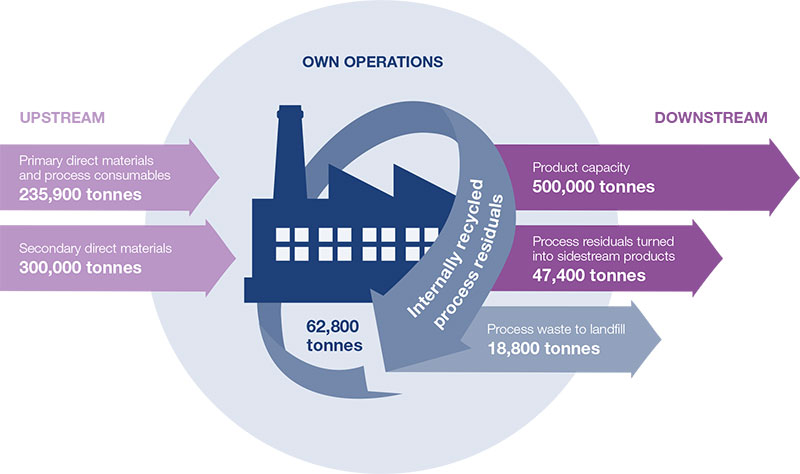
Primary raw materials such as iron ore and limestone are extracted from the earth’s crust and have a large environmental impact. Using secondary or recycled materials limits the negative impact, and our ambition is to use more of such materials.
Over the past five years, we have steadily increased the part of secondary raw materials, from 48 percent in 2021 to 59 percent in 2025. This is a result of deliberate choices. Significant shares of primary ferrous materials have been replaced by scrap.
Process residuals
We are actively promoting the use of our process residuals, and the target is to use at least 95 percent of the material produced in 2026 and onwards. For example, of our different types of slags, three are marketed as Petrit® and are registered under the EU regulation REACH.
In 2025, 96 percent of our process residuals were diverted from disposal. During the year, 47,400 tonnes (42,000), – corresponding to 37 percent (33) of Höganäs’ total process residuals – were repurposed by external partners.
Own workforce
Health and safety
Höganäs aims to create a safe, diverse and healthy work environment, free from all kinds of discrimination. Our guiding principle is ‘We work safely – or not at all’. We are committed to fostering a robust safety culture where open dialogue and proactive risk elimination are fundamental.
Our long-term target is Zero accidents. The year showed an increased number of recordable injuries compared with 2024, and the TRIFR (Total recordable injury frequency per million hours worked) was 8.0 (7.0), still below the target of 9.0 for 2025. The target for 2026 is a TRIFR of 7.0
We are proactively building the foundation by developing and implementing Group standards for all key aspects of health and safety, and by engaging the workforce through participation programmes such as safety walks and safety conversations.
Diversity and inclusion
At Höganäs, we know that diversity and inclusion drive creativity, innovation and growth. By welcoming different backgrounds and perspectives, we make better decisions and attract a broader range of talent. Recent years have brought a clearer strategy, stronger awareness, and the integration of diversity and inclusion into all people processes.
Höganäs has set targets to achieve 20 percent female co-workers and 35 percent female executive managers by 2026. In 2025, the target for female co-workers was achieved, with women representing 20 percent of the workforce, while women accounted for 32 percent of executive managers.
Workers in the value chain
Höganäs’ ambition is to lead the industry in responsible sourcing, and to excel in managing ethical, social and environmental aspects in the value chain. This includes promoting safe and healthy workplaces for workers across the value chain, guaranteeing labour rights and a living wage that meets their basic needs.
Our target is that year by year all of our key suppliers will be rated as good or excellent in the evaluations performed under our Responsible Sourcing Programme. In 2025, 90 percent (80) were assessed as good or excellent.
Business conduct
We hold ourselves and our business partners to high ethical standards to ensure that we contribute to a better society for all, including affected communities. Höganäs has zero tolerance of corruption and aims to work with suppliers to improve their performance.
During the year, 14 (15) new cases were submitted through our whistleblowing function. All cases were handled and closed in accordance with established procedures. No incidents relating to discrimination, corruption or human rights were reported through our internal channels.
We take our responsibility to safeguard our customers’ data and privacy seriously and have policies, routines and systems in place. During the year, we have had 0 (0) reported breaches of privacy or data losses.